


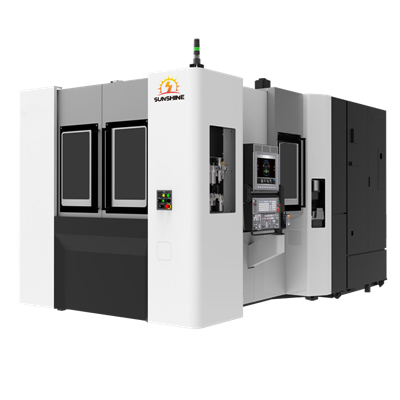
Horizontal Machining Center HMC1814
Horizontal machining center HMC1814 is a specific model of CNC machine tool, mainly used for milling, drilling, boring and other processing tasks of various metal workpieces.
1. High precision: The horizontal milling machine adopts advanced CNC system and servo drive technology to ensure processing accuracy.
2. High rigidity: The horizontal milling machine has a reasonable structural design, strong rigidity, and is suitable for heavy cutting.
3. Flexibility: The horizontal milling machine can be customized according to customer needs to meet different processing needs.
4. Intelligence: The horizontal milling machine is equipped with an advanced CNC system, with functions such as automatic programming and automatic tool change to improve processing efficiency.
Horizontal milling machine 1814 is widely used in automobile, aviation, mold, machinery and other industries, especially suitable for processing complex parts such as box, shell, pump body, etc.
Technical parameters
| Models | HMC1075 | HMC1290 | HMC1395 | HMC1814 |
| Table size (mm) | 1300X600 | 1360X700 | 1400X700 | 2000X900 |
| Maximum allowable load (Kg) | 800 | 1000 | 1000 | 1600 |
| X-axis travel(mm) | 1000 | 1200 | 1200 | 1800 |
| Y-axis travel (mm) | 750 | 800 | 800 | 1280 |
| Z-axis travel(mm) | 800 | 700 | 750 | 900 |
| T-slot | 5-18-105 | 5-18-122 | 5-18-122 | 5-22-165 |
| Distance from spindle end face to work table (mm) | 115-915 | 180-880 | 168-918 | 200-1100 |
| Distance from spindle center to Z-axis guide surface (mm) | 110-860 | 140-940 | 260-1060 | 140-1420 |
| Spindle taper | BT50-150 | BT50-190 | BT50-190 | BT50-190 |
| Spindle speed(r/min) | 6000 | 6000 | 6000 | 6000 |
| X/Y/Z rapid movement (m/min) | 20/12/20 | 20/12/20 | 20/12/20 | 18/12/18 |
| Machine weight(Kg) | 8000 | 10000 | 10000 | 15000 |
Shandong Sunshine Machinery Co., Ltd. :Your Professional Horizontal Turning Center Supplier!
Since its establishment, our company has always been committed to the research and development, manufacturing, sales and service of high-end CNC vertical lathes, and has always cooperated sincerely with our customers to jointly develop high-end CNC vertical lathes. High-end CNC equipment meets the processing needs of different industries.
Rich Product Range
The company's current mainstream products include: single column CNC vertical lathe series, double column double turret CNC vertical lathe series, moving column double column double turret CNC vertical lathe series, grinding wheel special CNC vertical lathe series, gantry dual spindle graphite special CNC vertical lathe series car series.
Wide Range of Uses
Our products are widely used in precision processing scenarios such as aviation, aerospace, high-speed rail, automobiles, motors, elevators, precision instruments, graphite materials, agricultural machinery, engines, etc.
Advanced Equipment
The company has advanced large-scale testing equipment and a gantry machining center. The gantry machining center can perform various milling operations such as plane milling, vertical milling, slot milling, etc., and is suitable for processing large plates, molds and complex curved surfaces.
Leading Service
We have many years of industry experience and a complete production management, quality supervision, sales service operation system. Whether you want to purchase a single-column CNC vertical lathe series or a special CNC vertical lathe series for grinding wheels, just send your requirements via email and we can customize the product for you.

Horizontal Machining Center HMC630
One of the main benefits of a Horizontal Machining Center HMC630 is its advanced chip management system. During machining, chips are automatically removed from the workpiece and directed to the chip conveyor for disposal. This ensures that the cutting area remains clean and free of debris, reducing the risk of damage to the machine and the workpiece, and improving the quality and consistency of the output.

Horizontal Machining Center HMC1075
The Horizontal Machining Center HMC1075 is designed for high-volume production, with its ability to handle multiple workpieces and perform multiple cutting operations simultaneously. It offers faster cycle times and higher production rates due to its high-speed spindle and efficient chip evacuation.

Horizontal Machining Center HMC1395
The Horizontal Machining Center HMC1395 is a cutting-edge machine tool designed to deliver high precision and productivity in metal cutting operations. With its unique horizontal orientation, this machine provides high stability and rigidity during machining, resulting in superior surface finish, accuracy, and repeatability.

Horizontal Machining Center HMC1814
One of the key features of Horizontal Machining Center HMC1814 is their ability to provide unmatched after-sales support. These machines are often used for heavy-duty machining operations, which means that they may require frequent maintenance and repairs. With a reliable after-sales support system in place, customers can rest easy knowing that their machines will be back up and running in no time.

Horizontal High-Speed Machining Center
A Horizontal High-speed Machining Center (HMC) is a type of computer numerical control (CNC) machine tool designed for high-speed milling, drilling, and boring operations. It is characterized by its horizontal spindle orientation, which allows for the efficient cutting of workpieces that are positioned parallel to the ground.

The spindle is the core part of the machine tool, and the speed and accuracy of the spindle are also very important parameters. High speed, high rigidity spindle units enable high speed, high precision machining, thereby improving production efficiency and quality. The use of high-precision roller screws for three axes is another important design feature. Roller screw has high bearing capacity and motion accuracy, which can ensure the stability and machining accuracy of the machine tool.

High Precision Horizontal Machining Center
The horizontal machining center is an efficient and high-precision machine tool suitable for small and medium-sized batches of complex shape processing and production requiring high precision. It has the advantage of strong comprehensive processing ability and can complete various types of processing tasks, such as milling, drilling, boring, tapping and so on.

Horizontal Machining is an advanced CNC machine tool, widely used in machinery manufacturing, aerospace, automotive, electronics and other industries. The machining center can be divided into horizontal machining center and vertical machining center. Among them, the horizontal machining center has significant advantages in chip removal, complex concave and mold cavity processing, especially suitable for processing large workpieces.

CNC Horizontal Machining Center
The CNC Horizontal Machining Center has the advantages of high automation, high processing efficiency and manpower saving. By using high precision numerical control system, it can realize the automatic processing of multi-face milling, drilling, boring and other processes, which greatly improves the production efficiency. In addition, automatic processing can also reduce the influence of human factors on processing accuracy and ensure the stability of processing quality.
A Horizontal Turning Center, also known as a CNC Lathe, is a type of machining center designed for rotating workpieces around their axis while various cutting tools perform operations such as turning, facing, drilling, boring, and threading. In contrast to vertical lathes, the main spindle of a horizontal turning center is oriented horizontally.
Features of Horizontal Turning Center
Multi-Axis
Turning centers typically have multiple axes of motion, including X, Z, and sometimes additional axes, such as a C-axis for live tools or a Y-axis for eccentric milling operations. This multi-axis capability enables complex machining operations and the production of complex geometries.
Automatic Tool Changer
Many turning centers are equipped with automatic tool changers that allow for quick and seamless tool changes during machining operations. This increases efficiency and reduces downtime between operations.
Power Tools
Some advanced turning centers are equipped with live tool capabilities that can perform milling, drilling and other secondary operations in addition to turning. Powered tools expand the range of processes that can be performed on the machine.
Chip Management System
Effective chip evacuation is critical to maintaining machining efficiency and surface finish. Turning centers often have chip conveyors or other chip management systems to remove chips from the work area.
Parts of Horizontal Turning Center


Main Spindle Area
The main spindle area is responsible for holding the cutting tools and providing the necessary rotation for machining operations. It houses the motor drives and spindle head, contributing to the accuracy and efficiency of the process. The spindle area plays a pivotal role in achieving desired surface finishes and precision in workpieces.
Taper Feed Mechanism
The taper feed mechanism is an essential part of the machining center that allows for the precise positioning and movement of the cutting tools. It controls the depth and orientation of the tools, ensuring smooth and accurate cuts. This mechanism works in coordination with the servo motor, making it a crucial component in determining the quality of the finished product.
Automatic Tool Changer (ATC) System
The automatic tool changer (ATC) system is a groundbreaking feature in machining centers. It provides quick and efficient tool changes, reducing manual intervention and cycle time. The ATC system includes a tool magazine where different cutting tools are stored, enabling the machine to switch between tools seamlessly. This enhances production efficiency and offers versatility in machining operations.
Tool Magazine
The tool magazine is an integral part of the ATC system. It stores various cutting tools such as end mills, drills, and more, providing a central repository for the tools needed in the machining process. The tool magazine ensures that the correct tool is selected and placed in the spindle, facilitating quick changes and continuous operations.
Automatic Pallet Changer (APC) System
Designed to increase throughput and minimize downtime, the automatic pallet changer (APC) system automates the loading and unloading of workpieces. The APC system consists of multiple pallets that can be preloaded with raw material, allowing for uninterrupted machining. This automation significantly enhances production efficiency, reducing manual handling and errors.
Chip and Coolant Handling System
Machining processes generate chips and require cooling to maintain tool life and part quality. The chip and coolant handling system manages these aspects, collecting chips through chip conveyors and providing the necessary coolant to the cutting area. This system ensures a clean and efficient working environment, contributing to the machine's longevity and performance.
Overload and Wear Detectors
Machining centers are equipped with overload protection devices and wear detectors to monitor tool wear and machine performance. These sensors detect abnormal conditions, such as tool breakage or excessive load, and provide alerts to prevent potential damage. These features add a layer of safety and reliability, ensuring consistent quality and minimizing unplanned downtime.
Automatic Door Operation Mechanism
Modern machining centers often include an automatic door operation mechanism that provides easy access to the work area. This feature adds convenience and safety, allowing operators to load and unload workpieces effortlessly, without the need to manually open and close heavy doors.
How to Choose Horizontal Turning Center
Define Your Requirements
Start by defining the type of work you'll be doing on the turning center. Consider the materials you'll be working with, the size and complexity of the parts, and the level of precision required.
Machine Size
Determine the size of the parts you'll be machining. Make sure the turning center has enough swing diameter and distance between centers to accommodate your largest parts.
Spindle Power and Speed
Consider the spindle power and speed requirements based on the materials you'll be machining and the type of cuts you'll be making. Higher spindle speeds are typically required for machining harder materials.
Tooling Options
Check the tooling options available for the turning center. Make sure it supports the types of tooling you'll need for your specific applications.
Accuracy and Precision
Evaluate the accuracy and precision of the turning center, including factors such as repeatability, positioning accuracy, and surface finish capabilities.
Control System
Consider the control system used in the turning center. Make sure it's user-friendly and supports the programming languages you're comfortable with.
Automation and Integration
Determine whether you need any automation features, such as automatic tool changers or robotic loading systems. Also, consider the integration capabilities with other machines or systems in your production environment.
Maintenance and Support
Research the reputation of the manufacturer and their track record for reliability, service, and support. Look for a machine with a strong warranty and readily available spare parts.
How to Maintain Horizontal Turning Center
Regular Cleaning
Keep the machine clean from chips, debris, and coolant residues. Regularly clean the surfaces, including the bed, chuck, and tool turret, to prevent buildup that can affect accuracy and performance.
Lubrication
Follow the manufacturer's recommendations for lubricating the machine's moving parts. Proper lubrication helps reduce friction, wear, and the risk of breakdowns. Check and refill lubricants as needed.
Inspecting Wear Parts
Regularly inspect wear parts such as belts, bearings, and guide rails for signs of wear and damage. Replace any worn or damaged parts promptly to prevent further issues.
Checking Alignment
Periodically check the alignment of the machine components, including the spindle, turret, and tailstock. Misalignment can lead to poor machining results and premature wear of components.
Calibration
Calibrate the machine regularly to ensure accurate positioning and machining. This includes checking and adjusting the accuracy of axis movements, tool offsets, and spindle alignment.
Coolant System Maintenance
Maintain the coolant system by regularly cleaning filters, checking fluid levels, and ensuring proper coolant flow. Clean coolant helps dissipate heat and remove chips, improving machining performance and tool life.
Electrical System Inspection
Inspect the electrical components and connections for signs of wear, damage, or overheating. Tighten loose connections and replace damaged components as needed to prevent electrical issues.
Frequently Asked Questions
Q: What is a horizontal turning center?
Q: How does a horizontal turning center differ from a vertical turning center?
Q: How does spindle power and speed affect machining on a horizontal turning center?
Q: How does accuracy and precision impact machining on a horizontal turning center?
Q: How can maintenance practices impact the performance of a horizontal turning center?
Q: How does regular cleaning contribute to the performance of a horizontal turning center?
Q: Why is lubrication important for a horizontal turning center?
Q: How does inspecting wear parts contribute to the reliability of a horizontal turning center?
Q: Why is calibration necessary for a horizontal turning center?
Q: What role does the coolant system play in the operation of a horizontal turning center?
Q: How do automation features benefit horizontal turning centers?
Q: How does the control system of a horizontal turning center impact its usability?
Q: How does the accuracy of a horizontal turning center impact its suitability for precision machining applications?
Q: How does the cost of a horizontal turning center affect the decision-making process for manufacturers?
Q: How do manufacturers ensure the compatibility and integration of a horizontal turning center with existing production systems?
Hot Tags: horizontal machining center hmc1814, China horizontal machining center hmc1814 manufacturers, suppliers, factory, horizontal machining center for drilling, horizontal machining center for gear shaping with grinding, horizontal machining center with chip removal system, 5 Axis Horizontal Machining Center, horizontal machining center for gear deburring with chamfering, horizontal machining center for gear deburring
You Might Also Like




Send Inquiry