


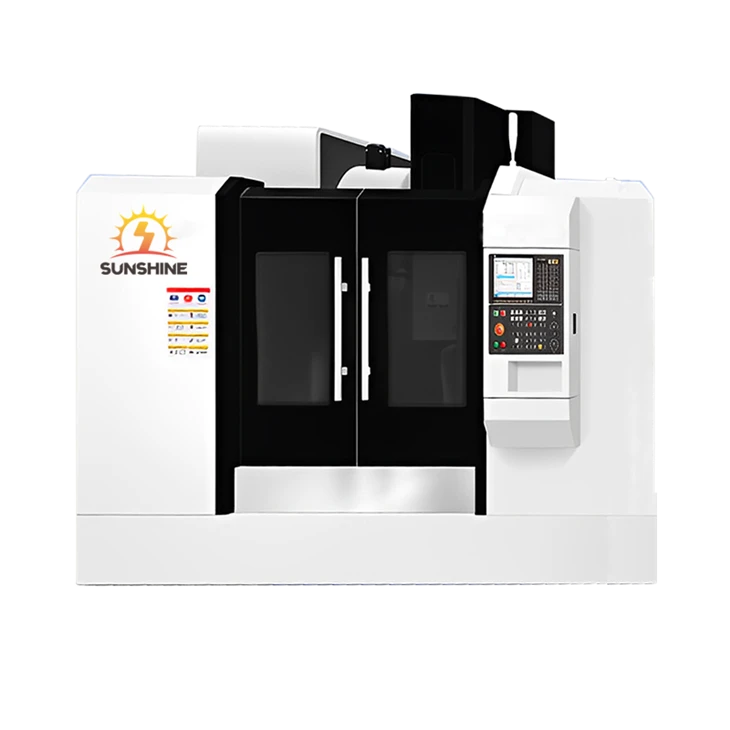
Milling and Drilling Machining Centers
Our milling and drilling machining centers are all-in-one CNC machines built for real-world manufacturing. They combine fast drilling, accurate milling, and reliable tapping in one setup, so you can process metal parts efficiently without moving workpieces between machines. Ideal for automotive parts, 3C components, molds, fixtures, and general engineering, these machines help you cut cycle times, improve consistency, and lower labor costs. Built with rigid structures and stable control systems, they run smoothly for long hours and keep precision steady batch after batch.
Technical parameters
| Specifications | unit | VMC1160 | VMC1370 | VMC1580 |
| Table size | mm | 1200x600 | 1500x700 | 1700x800 |
| Table maximum load | kg | 1000 | 900 | 1500 |
| X//Z axis travel | mm | 1100x600x600 | 1300x700x700 | 1500x800x700 |
| Distance between spindle centerand column | mm | 650 | 752 | 871 |
| Distance between spindle endface and worktable surface | mm | 120-720 | 150-850 | 150-900 |
| X//Z Max. feed speed | mm/min | 10000 | 8000 | 10000 |
| X//Z Max. Rapid traverse | m/min | 32/32/30 | 20/20/15 | 20/20/16 |
| spindle speed | r/min | 8000 | 8000 | 8000 |
| spindle taper | type | BT40 | BT40 | BT50 |
| Spindle motor power | kW | 11/15 | 11/15 | 15/18 |
| X//Z axis servo motor power | kW | 4/4/5 | 4/4/5 | 4.5/4.5/4.5 |
| X//Z motor connection | Direct | Direct | Direct | |
| X/Y/Z Guide way type | third line | Two lines and one hard line | Two lines and one hard line | |
| T slot | mm | 5-18x100 | 5-18x145 | 5-22x145 |
| Repeat positioning accuracy | mm | ±0.005 | ±0.005 | ±0.005 |
| Tool magazine | disc type | disc type | disc type | |
| Tool capacity | 24T | 24T | 24T | |
| Maximum tool weight | kg | 8 | 8 | 15 |
| MMax. tool length | mm | 300 | 300 | 300 |
| Electric capacity | kVA | 18 | 22 | 30 |
| Machine dimension(LxWxH) | mm | 3100x2490x2380 | 3600x3000x2700 | 4260x3545x3200 |
| Net. weight (about) | kg | 7000 | 11000 | 12000 |

CNC Machining Center VMC1160 High-precision Screw With High Precision And Stable Performance
CNC milling machine VMC1160 High-precision Screw With High Precision And Stable Performance is a high-precision, high-performance, high-reliability processing machine tool. CNC milling machine uses a high-quality screw to ensure the accuracy and stability of the machine tool movement during processing. It can also meet the needs of high-speed processing and various high-precision processing needs.

Our CNC vertical drilling and tapping tool change machining center and metal cutting automatic tool changer are efficient metal cutting equipment, and CNC milling machines can be used to process various parts. CNC milling machines adopt CNC technology, are simple and convenient to operate, and have a sufficient level of automation, which can greatly improve production efficiency.

VMC855CNC Vertical Machining Center Computerized Gong Machine Metal Cutting
VMC855CNC vertical machining center computer gong machine metal cutting is an advanced CNC machine tool specially used for metal cutting. This CNC milling machine adopts a vertical structure design, which can achieve high-precision processing and is suitable for processing various metal materials.

CNC Machining Center Metal Mold Processing
CNC machining centers are high-precision computer-controlled machines used for metal mold processing. CNC milling machines combine the functions of milling, drilling, and sometimes turning into a single unit, allowing complex shapes and features to be created directly from a solid block of metal (usually hardened steel or aluminum).

Automated Vertical Machining Center Milling Machine
An automated vertical machining center (VMC) milling machine is a computer-numerically-controlled (CNC) milling machine designed with an automatic tool changer and often a pallet changer to increase efficiency and throughput in the machining process. The "vertical" aspect refers to the orientation of the spindle, which moves up and down (vertically) along the Z-axis.

CNC Machining Center Power Turret Complex Process Molding in One Go
The CNC milling machine power tool holder is a kind of mechanical processing equipment that can process various complex parts with high precision through computer numerical control technology. It has the characteristics of high speed, high precision and high efficiency. It is widely used in various fields of manufacturing industry. The power tool holder of CNC machining center is one of the most important processing equipment.

High Performance Mold Processing Center
High-performance mold CNC milling machines are machine tools in the mold processing field that can quickly, efficiently and accurately complete high-precision drilling tasks. CNC milling machines use advanced technology and design concepts to output high-speed, high-precision processing results, and minimize adverse effects such as vibration and noise, thereby achieving the goal of high performance and low vibration.

1160 Machining Center For Graphene
The 1160 graphene processing center is a machine tool specially customized for graphene processing. This CNC milling machine processing center integrates a series of professional manufacturing technologies for graphene processing. It can efficiently and accurately complete various types of graphene processing, effectively improving the efficiency and accuracy of graphene processing.

Vertical Machining Center CNC Milling Machine VMC1160 Graphite Mold High Speed Hardware
This vertical machining center CNC milling machine VMC1160 graphite mold high-speed hardware is a vertical design, suitable for processing small and medium-sized parts, simple operation, high degree of automation, high processing precision, the CNC milling machine adopts high-performance spindle and intelligent control system, which can quickly complete complex processing work when manufacturing various molds.
Milling and drilling machining centers are advanced CNC machine tools designed to perform a variety of machining operations, primarily milling and drilling, but often also including other processes such as tapping, drilling, and reaming. CNC lathes are an indispensable part of manufacturing, used to produce precision parts from a variety of materials.
Product Features
Creation of Complex Parts and ProductsCNC milling machining centers can create some of the most complex geometries that other traditional methods may struggle to achieve due to their precision and adaptability.
Enhanced Productivity
The less time a CNC milling machine is idle, the more it can produce. By significantly reducing tool change time, the increased productivity of CNC milling machines not only meets the growing demands of consumers, but also enables manufacturers to take on larger orders with confidence.
Reduced Manual Intervention
In multi-axis CNC milling, the need for the operator to reposition the workpiece is minimized or even eliminated. The advanced motion of a CNC milling machine ensures that it can access the most challenging parts of the material, ensuring smooth production without human intervention.
Intricate Designs in Fewer Steps
CNC milling machinesWith simultaneous multi-axis motion, jobs that previously required multiple setups and adjustments can now be completed in a single machine. CNC milling machines can rotate, turn, and approach materials from different angles, allowing complex designs to be carved out in fewer steps, saving time.
Product Type


Vertical Machining Centers (VMC)
These are the most common type of machining centers. The spindle axis is vertical, making it easier to load and unload workpieces and ideal for machining tall and slender parts.
Horizontal Machining Centers (HMC)
In these machines, the spindle axis is horizontal. They are more stable and capable of handling heavier workloads and larger workpieces. They are also better suited for machining deep cavities and complex surfaces.
Universal Machining Centers
These machining centers have the ability to tilt the spindle head to any angle, allowing for greater flexibility in machining different types of parts.
CNC Machining Centers
These machining centers are equipped with a worktable that can position the workpiece at any angle. This enables the machine to perform five-axis machining, which can produce very complex shapes and surfaces.
Bridge Machining Centers
CNC lathes are large, heavy-duty machine tools with a bridge-type structure that have excellent rigidity and stability. They are designed specifically for high-speed, high-precision machining of large workpieces.
Gantry Machining Centers
These machines have a gantry-type construction that provides excellent access to the workpiece from all sides. They are designed for machining large, bulky workpieces and are often used in the aerospace and defense industries.
Modular Machining Centers
CNC milling machine is a kind of machine tool equipment widely used in industrial production, mainly used for processing various parts with complex shapes such as planes, grooves, contours, etc.
Product Composition
Bed
Typically constructed from cast iron for enhanced durability and strength, the bed is the machine's foundation, supporting all components.
Spindle
Inside the machining area, the electrically driven spindle rotates tools that cut and shape the parts. The inside of the spindle is tapered to match the tapered angle of the tool holder to maximize the surface contact that is required to hold the tool in place while cutting. A drawbar inside the spindle grips and pulls the retention knob on the tool holder to secure the tool in the spindle. The spindle on a horizontal machine holds the tool horizontally, and a vertical machine holds it vertically, thus the name for each.
Pallet
The pallet on a horizontal mill is used to mount the machining fixtures for particular parts to hold parts that are being machined. Fixtures firmly hold the part in an exact location and position. The pallets have aligning blocks on two sides that are used to locate the fixture into a location prior to being bolted in place. A horizontal machining center has two pallets. The operator can process parts on the pallet in the loading station while the second pallet is in the machining station having parts machined
Control Panel
The control panel includes the input device, display unit, keyboard, and control buttons. Typically mounted on an extendable arm for easy positioning, it plays a crucial role in inputting programming instructions into the machine, complementing the machine control unit's functions.
Display
Varying in size and resolution, this screen shows essential information for operator interaction: G-code, settings, and the machine's operating status. By presenting programs, instructions, and real-time machine status, this unit ensures effective management and control of the CNC machine.
Machine Control
The MCU interprets G-code and handles operations such as task initiation, spindle speed, tool changes, and feed rate management. It translates G-code into instructions for tool drivers, coordinating servo motor movements across axes and ensuring tool accuracy with feedback sensors.
How to choose
Workpiece Size and Weight
According to the size and weight of the workpiece you plan to process. Make sure the machining center you choose has a large enough reach and enough load capacity to meet your specific needs.
What Materials are Processed?
Determine the material you will primarily be using, such as the type of metal, plastic or composite. Make sure the machining center you choose is capable of handling these materials efficiently and effectively.
What Type of Spindle, RPM and Power is Required?
Evaluate your machining requirements to determine the proper spindle speed and power required for your operation. Different types of spindles have different milling capabilities, high-speed spindles are essential for precise, delicate work, while more powerful spindles may be required for heavy-duty machining tasks.
Tool Storage Capacity Required?
Consider the number of different tools required for a machining operation to select an appropriate automatic tool changer and ensure that the machining center's automatic tool changer has sufficient storage capacity to accommodate them.
Popular CNC Controllers?
Choose the CNC controller you are proficient in to meet your usage habits. In addition, the popular CNC controller can also reduce the training time of workers and facilitate the recruitment of skilled operators and programming workers.
Do You Need 4 or 5 Axes?
Does your part require multi-sided machining? In this way, I suggest that you choose a 4-axis or 5-axis rotary table to achieve multi-face machining in one clamping, which can greatly improve processing efficiency and reduce errors caused by multiple clamping.
Need to Automate?
Evaluate the level of automation you require, such as automatic tool changers, pallet changers, or robotic loading and unloading systems, to improve productivity and reduce labor costs.
Service and Support
Investigate the level of service and support offered by the manufacturer or distributor, including training, maintenance, and spare parts availability. A reliable support network is crucial for minimizing downtime and ensuring the machine's longevity.
How to Maintain
Clean the Machine
After each shift, or at the end of the day, clean the machine of chips and coolant. Use compressed air to blow out debris from hidden areas.
Check Coolant Levels
Ensure that the coolant reservoir is filled to the appropriate level. If necessary, replace or top up the coolant.
Inspect For Leaks
Look for any signs of oil or coolant leaks around fittings, hoses, and seals. Tighten connections and replace worn seals if necessary.
Lubricate Moving Parts
Apply lubricant to all moving parts, such as ball screws, linear guides, and dovetail ways, to reduce wear.
Inspect Tool Magazine
Check the tool magazine for proper alignment and damage to tool holders. Clean and lubricate as required.
Clean Filters
Clean or replace air, hydraulic, and coolant filters to maintain system efficiency.
Check Spindle Bearings
Listen for unusual noises that may indicate bearing wear. If bearings are found to be worn, they should be replaced.
Examine Guideways
Inspect the linear guideways for wear and ensure they are properly lubricated.
Calibrate Machine
Check and calibrate the machine's accuracy using precision measuring tools to ensure it maintains its cutting tolerance.
Inspect Cables and Hoses
Check all electrical cables and hydraulic hoses for wear and damage. Replace any suspect items to prevent failures.
Replace Cutting Fluid
Drain and replace the cutting fluid according to the manufacturer's recommendations. Clean the fluid reservoir and associated plumbing.
Inspect Electrical System
Test the electrical components, including switches, relays, and motors, for proper function and check for loose or corroded connections.
Perform a Major Service
This should include a complete breakdown and cleaning of the entire machine, replacement of consumable parts like cutting tools and inserts, and a thorough inspection of mechanical, electrical, and hydraulic systems.
Alignment Check
Have the machine's alignment checked and adjusted if necessary to maintain cutting accuracy.
Software Updates
Ensure the machine's control software is up to date with the latest patches and improvements.
FAQ
Q: What is a Milling and Drilling Machining Centers?
Q: How does this device work?
Q: What are the main components?
Q: What are the advantages of using this device?
Q: What types of materials can it process?
Q: What are the differences between milling and drilling operations?
Q: What are some common applications of this device?
Q: What factors should be considered when making a choice?
Q: How do I change the cutting tools on this device?
Q: What safety precautions should be taken during operation?
Q: How is tool wear monitored and managed in a Milling and Drilling Machining Center?
Q: What are the advantages of using CNC technology in this equipment?
Q: How does high-speed machining (HSM) benefit this equipment?
Q: What are some common challenges this device faces?
Q: What role does the coolant play in this equipment?
Q: What are the differences between three-axis and multi-axis?
Hot Tags: Milling and drilling machining centers, China Milling and drilling machining centers manufacturers, suppliers, factory, vertical machining center for computer controlled production machining, Vertical Machining Center Working, vertical machining center for laser machining, vertical machining center with automatic tool changer, vertical machining center for titanium, vertical machining center for cloud based production machining
You Might Also Like


Send Inquiry